
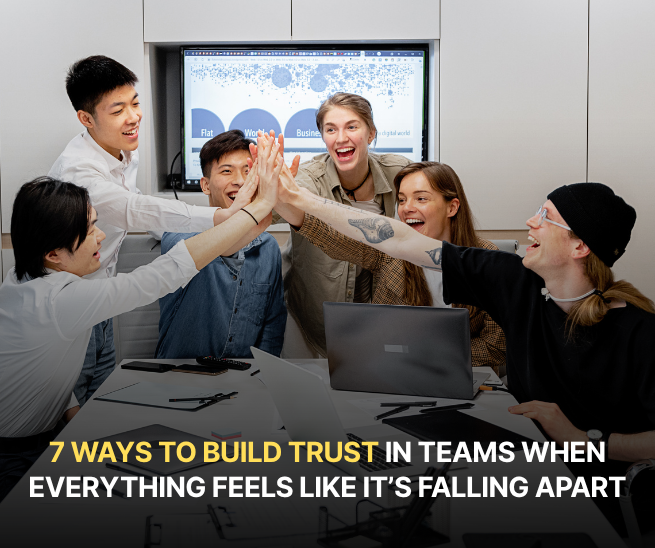
In the AI world, when it is reshaping roles faster than anyone planned – building trust is one of the most critical leadership skills, Your team is watching you more carefully than you realize – not just what you decide but how you show up when the ground is shifting.
Trust doesn’t disappear in a single moment. It erodes quietly through unanswered questions, inconsistent communication, and broken commitments.
And it is built the same way: quietly, consistently, in small moments.
The 2025 Edelman Trust Barometer found that 68% of people now distrust business leaders, up 12 points from the prior year marking a historic low at a moment when trust has never mattered more.
The good news: Trust is rebuildable. It starts with seven specific behaviors.
1. Name What’s Actually Happening
When uncertainty is high, silence from leadership doesn’t feel neutral. It feels like confirmation that things are worse than anyone is saying.
When people are quietly asking questions like – ‘Will my role still exist in two years? Does my manager actually know what’s happening? Can I trust that someone is thinking about us, not just the outcomes?’, the first trust-building act is simply naming reality — clearly, honestly, and without spin.
This doesn’t mean having all the answers. It means refusing to pretend the uncertainty isn’t there.
Research from Brené Brown’s work on leadership shows that leaders who acknowledge difficulty and uncertainty are rated significantly higher on trustworthiness than those who project false confidence or stay silent.
Teams don’t need leaders who have everything figured out. They need leaders who are honest about what isn’t figured out yet and what is being done about it.
In practice: Open team conversations with what you know, what you don’t know, and what you’re doing to find out. Make this a regular cadence — not a one-time announcement.
2. Keep Your Word on Small Things
In high-uncertainty environments, people unconsciously test their leaders on small commitments.
Did you follow up when you said you would? Did you check in after that difficult conversation? Did you remember what someone shared with you last week?
Small kept commitments are how trust gets rebuilt or quietly lost.
Trust research consistently shows that reliability on small commitments is one of the strongest predictors of team trust. Studies found that decline in manager trust is most directly tied to inconsistency and broken follow-through.
When everything feels uncertain, consistency in small things signals that the leader is someone people can count on.
In practice: Under-promise and over-deliver. If you say you’ll get back to someone by Friday, get back to them. If you say you’ll look into something, report back even if the answer is “I don’t have an update yet.”
3. Create Space for the Questions People Are Afraid to Ask
AI anxiety, in particular, creates a specific kind of silence.
People have real fears about relevance, about job security, about whether their skills will matter in two years. But they rarely feel safe voicing these fears directly, because doing so feels like admitting vulnerability in a moment when they’re trying to appear capable and adaptable.
So the fear goes underground. It shows up as disengagement, resistance to new tools, or quiet attrition.
The 2025 KPMG American Worker Survey found that 52% of workers fear AI will eventually replace their jobs; nearly double the figure from the prior year. Gartner’s 2026 research confirms this further: widespread anxiety about AI-driven job loss is actively undermining productivity and slowing adoption across organizations.
In practice: Create explicit permission for these conversations. Say: “I know there are questions about what AI means for our team and our roles. I want us to be able to talk about that honestly — including the things we’re uncertain about.” The invitation matters as much as the answer.
4. Separate What You Can Control From What You Can’t And Be Clear About Both
One of the fastest ways to lose team trust during uncertainty is to speak with false confidence about things outside your control and then be proven wrong.
Teams are remarkably perceptive. They know when a leader is overpromising. And when reality contradicts the promise, trust doesn’t just dip; it drops.
Leaders who are honest about the limits of their control are consistently rated as more trustworthy, not less. Honesty about uncertainty signals integrity. Overpromising and being proven wrong signals the opposite.
In practice: Be explicit about your sphere of influence. “This decision is being made above my level and I don’t have visibility into the full picture yet but here’s what I can commit to within our team.” That sentence builds more trust than a polished answer that later proves hollow.
5. Show Up Consistently Not Just in Crisis
Leaders who only appear when things go wrong teach their teams that presence means problems.
Trust is built in the ordinary moments — the regular check-ins, the quick acknowledgments, the casual conversations that signal: I see you, I’m here, you’re not invisible.
In fast-changing environments, these touchpoints become anchors. They communicate stability not through grand gestures but through reliable, unglamorous presence.
DDI’s Global Leadership Forecast 2025 spanning 50 countries and nearly 13,000 leaders found that trust in immediate managers dropped from 46% to 29% between 2022 and 2024. The primary driver: leaders who were absent, inconsistent, or only visible during problems.
In practice: Don’t let your calendar fill entirely with strategic meetings. Protect time for informal connection — brief check-ins, open-door moments, walking the floor.
6. Acknowledge Mistakes and Course Correct Visibly
In turbulent times, leaders are making faster decisions with less information. Some of those decisions will be wrong.
How a leader handles being wrong matters more than being wrong.
Leaders who acknowledge mistakes openly and course correct without defensiveness model the psychological safety that allows teams to do the same. Leaders who defend wrong decisions, minimize them, or quietly revise history without acknowledgment teach their teams that mistakes are dangerous.
Amy Edmondson’s foundational research on psychological safety validated across decades and multiple industries found that teams where leaders openly acknowledge mistakes report significantly higher learning behavior, innovation, and performance than teams where errors are minimized or hidden.
In practice: When you get something wrong, name it directly. “I made a call last week that I’ve since reconsidered — here’s what I’m changing and why.” That sentence doesn’t weaken your authority. It strengthens it.
7. Advocate Visibly for Your Team
Trust is not built only through what happens inside the team. It’s built by what team members believe their leader is doing on their behalf — upward, outward, and across the organization.
In AI-driven change environments, this is particularly important. Teams need to know that someone with organizational influence is actively considering the human impact of decisions — not just the efficiency gains.
Research from Zenger Folkman found that leaders rated highest on trustworthiness by their teams are significantly more likely to be seen as advocates — people who represent the team’s interests, push back on unreasonable demands, and make the team’s contributions visible to senior leadership.
Advocacy is not about being the team’s defender in every conflict. It’s about consistently signaling: I see what this team is carrying, and I will not let it go unacknowledged.
In practice: Make your advocacy visible, not just real. Tell your team when you’ve pushed back on something on their behalf. Share recognition they deserve. When decisions affect your team, be the voice that asks: “What does this mean for the people doing this work?”
The Foundation Beneath All Seven
Every one of these behaviors rests on the same foundation: treat your team as people navigating genuine uncertainty — not as resources who have to be managed.
That distinction sounds subtle. Teams feel it immediately.
In an era of rapid AI-driven change, the manager who builds trust isn’t the one with the best answers. It’s the one who shows up honestly, consistently, and with genuine care for the humans they lead.
That is what steadies a team when everything feels like it’s falling apart.
Final Thought
Trust is not built in the big moments of leadership. It is built in the accumulated weight of small, consistent, human choices.
Your team is not looking for a leader who has everything figured out. They’re looking for one they can count on even when nothing is certain.
In the AI era, that kind of leadership is not a soft skill. It is the skill.
👉 Which of these seven behaviors do you find hardest to keep up when things get difficult?

Get the support you need to redefine your growth strategy, quickly respond to change and accelerate your path to success.

