
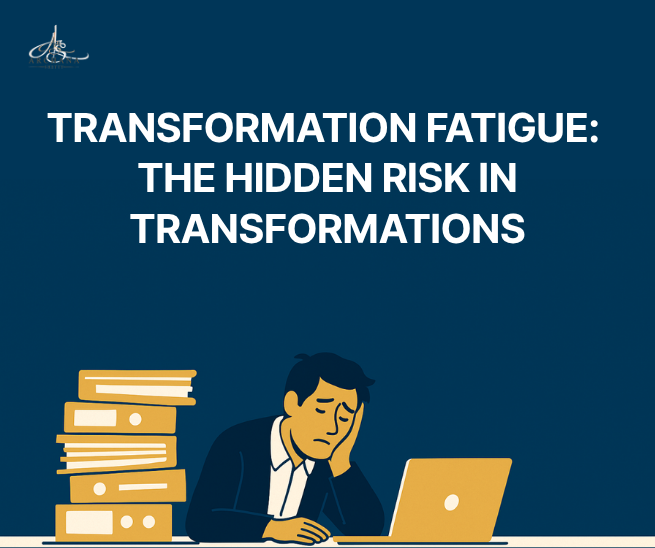
Have you noticed transformations that begin with excitement but lose momentum during execution?
They start with a clear intent, strong sponsorship and a sense of urgency that mobilizes the teams. Then, somewhere along the way, energy dips, momentum slows and engagement drops.
This is often described as transformation fatigue. Not resistance, but gradual disengagement.
Most leaders anticipate resistance in transformation.
Few anticipate fatigue.
But fatigue is not the same as resistance.
Resistance pushes back.
Fatigue withdraws.
And that makes it harder to detect.
Research from Harvard Business Review describes change fatigue as a response to sustained organizational change without sufficient clarity or recovery. Employees’ ability to absorb change is finite; when that threshold is exceeded, execution quality declines.
In practice, this means transformation does not stop, it becomes less effective.
Transformation fatigue shows up subtly:
Leaders may interpret this as capability gaps.
But more often, it is a capacity and clarity gap.
In my experience working with large-scale digital and AI initiatives, I have seen that fatigue doesn’t come from the volume of change alone.
It comes from how that change is experienced and is the result of compounding pressures from multiple factors like
:
Three structural issues consistently drive fatigue:
Organizations often launch multiple initiatives simultaneously:
New tools.
New processes.
New priorities.
But when the connection between these initiatives and purpose is weak, people struggle to anchor themselves.
Research from Boston Consulting Group shows that transformations with a clearly articulated narrative and linked initiatives are significantly more likely to sustain momentum. Without that narrative, change feels like motion — not progress.
Transformation plans typically account for:
But rarely for how people are processing the change.
Uncertainty, role shifts, and capability gaps create internal pressure. When that pressure isn’t acknowledged, it accumulates and shows up as disengagement.
In dynamic environments, priorities evolve. That’s expected.
But when initiatives are frequently reshaped without clear direction, teams experience fragmentation. Work feels unfinished. Effort feels diluted. Over time, teams lose focus
Research from McKinsey & Company shows that competing initiatives dilute focus and reduce the likelihood of sustained performance improvement.
Leaders who navigate transformation fatigue well don’t simply accelerate or pause. They recalibrate.
Transformation needs a powerful narrative that evolves with it.
Not just:
“What are we doing?”
But:
“Why are we doing and how does this still matter now?”
They continuously reconnect transformation to purpose: Revisiting and reinforcing purpose restores meaning and meaning restores energy.
In fast-moving environments, emotional connection slowly disappears.
Effective leaders intentionally create space to:
These moments help teams process, not just perform.
When everything feels important, nothing feels meaningful.
Strong leaders make deliberate choices about:
Focus reduces fatigue.
Fatigue thrives when effort feels invisible.
Leaders who highlight:
rebuild confidence in the journey.
Transformation is not a sprint but a marathon.
It requires sustained effort over time.
Organizations that operate in continuous urgency often see declining returns.
Those that manage pace deliberately sustain execution quality.
Fatigue is not a sign that people are unwilling to change.
It is a signal that the system of change is exceeding human limits.
And unless that system is adjusted, increasing effort will not restore momentum—
it will accelerate disengagement.
When momentum slows, the instinct is to push harder.
A more effective response is to step back and watch out for ‘Transformation fatigue’ that signals a need for greater clarity, stronger integration, and more deliberate prioritization.
The critical leadership question is not:
“Why aren’t we moving faster?”
It is:
“What is the experience of this transformation for our people right now?”
Because transformation does not succeed when systems change.
It succeeds when organizations maintain enough alignment, focus, and engagement for that change to take hold over time.

Get the support you need to redefine your growth strategy, quickly respond to change and accelerate your path to success.

